

We see artificial intelligence (AI) issues in the news almost every day. It can be overwhelming. Last Friday, Wayne County, Michigan made news when County Executive Warren Evans vetoed two resolutions approved by the County Commission related to Google’s hyperscale data center project in Van Buren Township (codename: “Project Cannoli”), which is in Wayne County. The Commission may override his veto if a two-thirds majority supports that action. We’ll have to wait and see. Let’s unpack what’s happening here and what’s at stake for the Township, the County, and the State of Michigan.
In a complex and rapidly evolving fiscal and policy environment, Watson & Yates demystifies the discussion and helps you decide how to adapt. Contact us today to schedule a scoping call.
What’s the deal here?
Back in May, Van Buren Township approved a Public Act 198 (PA 198) industrial facilities tax abatement for Google’s data center project. This abatement is frequently used throughout Michigan to incentivize manufacturing and high-tech companies to invest in new or improved buildings and new equipment. With no abatement, companies would pay additional real and personal property taxes on all of their new investment. That can discourage new investment unless it is still profitable after the new taxes.
For new construction, the PA 198 abatement reduces those new taxes in half for 12 years and can help companies make the business case for the new investment, and thus, the new jobs and, albeit discounted, property taxes it creates for the community. Whether the incentive is truly needed depends on the circumstances, and local governments should carefully evaluate its necessity before granting it. But competition between municipalities for the same project can quickly force one’s hand.
With the PA 198 abatement, Google’s Van Buren Township data center is estimated to save $125 million in property taxes over 12 years but also net the Township and its overlapping jurisdictions about the same amount in new tax revenue too (remember, it’s a 50% discount). For a data center like this, the new property taxes are weighted heavily toward the $2 billion in equipment inside (93% personal property) vs. the $152 million building (7% real property). More on this later. The Township also negotiated a $15.4 million upfront developer payment for local infrastructure projects.
Google is also seeking an exemption from the State of Michigan’s 6% sales and use tax on all the computer equipment and construction materials it will purchase to build and maintain the data center through 2050. This is all under new statutes passed during the Democratic-controlled 2024 lame-duck session along with some bipartisan support, MCL 205.54ee for the sales tax exemption and MCL 205.94cc for the use tax exemption. The State is making a calculation that the temporary construction jobs, permanent on-site jobs, and indirect benefits, all of which contribute to the economy and other tax revenue, make the sales tax exemption worth it. Michigan is competing with 38 other states, including our neighbors, for the same projects using similar tax breaks.
While there are no public figures for Google’s potential State sales tax break, let’s assume the $2 billion in equipment yields a sales tax exemption of at least $120 million (6%) immediately, with hundreds of millions to follow through 2050 as they refresh equipment. In their recent report evaluating data center policy issues, the Citizens Research Council (CRC) of Michigan estimates a sales tax exemption for the larger Saline Township data center could be worth up to $3.3 billion in foregone state tax revenue initially and then $600 million annually thereafter as they replace processors. The size of these projects’ sales tax breaks ultimately depends on the scale of their otherwise taxable equipment investments on site. But they are undeniably massive.
Why is Wayne County involved?
On September 15, the Wayne County Commission approved two resolutions about Google’s data center project, alongside other routine business like purchasing the former Comerica Bank office building in downtown Detroit for $25 million and approving the $2 billion annual county budget. The two resolutions would approve (1) receipt of the PA 198 “property tax benefits” approved by Van Buren Township and (2) a voluntary community benefits agreement with the developer valued at $15 million over 12 years for county infrastructure projects. As noted at the top, County Executive Evans vetoed these two resolutions, citing a “rushed process,” and putting Google’s PA 198 abatement in jeopardy. We’ll see the Commission’s response soon enough.
When I saw this news, I was immediately confused. Not about the policy debate but about the law. I always thought PA 198 property tax abatements were exclusively decided by the local city, township, or village. For better or worse, the county just bears its share of the abatement with no direct say in the matter. Despite my vast knowledge of arcane state laws and tax policy, this one had me stumped! Naturally, and unironically, I asked Google’s Gemini AI to explain while I was scouring the statutes. Here is what I got:
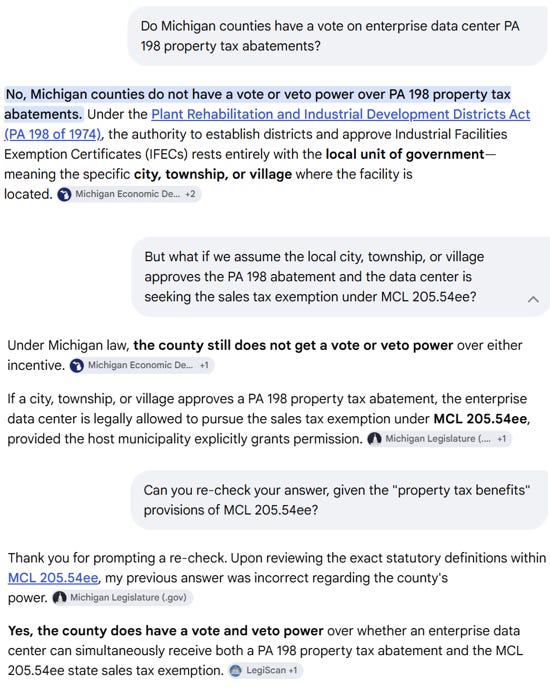
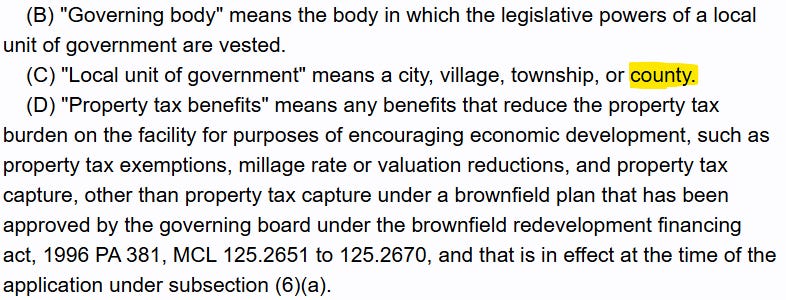
As you can see above, my questions evolved based on my own human research and review of the statute. When using AI tools, always check the sources and review the answers. They are useful tools but not always right! They can give vastly different results based on how you write your prompts. So, yes, it turns out Wayne County, and all counties for that matter, have a vote over enterprise data centers’ local property tax abatements if, and only if, the enterprise data center project is also seeking the state sales tax exemption. Counties have to approve “receipt of the property tax benefit,” which they can also leverage for new community benefits funding like the municipalities. Here are the applicable excerpts from MCL 205.54ee:


One more point about personal property taxes
I told you we’d come back to personal property taxes later. Stick with me just a little longer. The lion’s share of these enterprise data center investments are in the equipment (personal property) that makes them run, not as much the buildings (real property). For Google’s Van Buren Township data center, it is reported that $2 billion (93%) of the investment is in personal property. That is the bigger driver of the local property tax gains. CRC touched on this and related issues in a recent brief too.
Back in February, I wrote about Michigan House Speaker Matt Hall’s property tax cut pitch that would replace those cuts with new sales taxes on luxury services. As one piece of the package, the House passed HB 5878 in May, which would eliminate all personal property taxes in Michigan. The Senate has not acted on it. Speaker Hall cited utility companies, like DTE and Consumers Energy, as the largest beneficiaries from eliminating personal property taxes and passed HB 5879 to require them to pass those tax savings onto ratepayers if the whole package is enacted.
It is true that utilities pay the largest share of Michigan’s personal property taxes currently. Think of all the equipment they have sited in communities across the state. But the House legislation would also eliminate nearly all the new property taxes from enterprise data centers too! If this bill is enacted, the local tax revenue upside from Google’s project in Van Buren Township would disappear overnight.
The House also proposed, but has not yet passed, HB 5880 to create the luxury services replacement tax to backfill local revenue losses. It does not yet identify the targeted services. It makes the School Aid Fund whole first for the proposed State Education Tax and State Real Estate Transfer Tax cuts. It then says the remaining replacement revenues must be “prorated amongst the municipalities” based on 2026 personal property tax collections.
That means counties, cities, townships, villages, schools, and every local taxing unit would not be made whole for their personal property tax losses under House Republicans’ plan. Not based on the 2026 tax levels, and certainly not future levels driven by data center project investments. Fortunately, this legislation will not likely move any further this year. But it shows you how complex tax policy legislation can have dramatic impacts on local government finance beyond the immediate headlines.
Bottom Line: AI is a powerful tool, but we need to use it responsibly. It’s a machine, but it’s not perfect. It makes mistakes, but it can also do a ton of work in seconds! It’s not a substitute for human analysis and judgment. Similarly, local governments should rely on their best judgment and experts when weighing the pros and cons of hyperscale data center developments in their communities.
Data centers can be a tremendous add to the local property tax base, even despite the abatements, and that is worth consideration. But there are long-run risks around how personal property attached to these facilities will be taxed, including future tax policy changes, personal property depreciation, and the uncertain future of AI-driven business behind these data centers. The State of Michigan should absolutely set standards for data center developments, and their impact on utilities and the environment, while leaving local governments with the choice to welcome them or not.